Black Jade Meaning: Colour, Material and Choosing a Budai Pendant
Published 18 October 2026 · Laughing Buddha Statue
“Black jade meaning” can refer to two different questions: what a dark keepsake represents to its owner, and what material the object actually is. Those questions should be kept separate. A personal association with strength or steadiness is not a gemstone identification, and a black-looking photograph does not establish jadeite or nephrite.
When the piece is carved as Budai, you can also consider the figure’s familiar associations with joy and contentment. Its colour, its material and its subject each contribute something different to the choice.
Is black jade a single material?
Black is an appearance description, not a complete mineral name. GIA documents black nephrite and blackish-green omphacite jade, and includes black among jadeite’s colours. These examples show why a seller should identify the material more specifically where possible.
For a purchase, ask whether the description is supplier-provided or independently tested. If treatment status, origin or material identity is essential to your decision, request supporting information for that item rather than relying on the broad phrase “black jade.”
Why a dark pendant can look green in strong light
A piece may look nearly black in ordinary reflected light yet show green through a thin area when light passes through it. GIA’s report on particular blackish-green omphacite samples illustrates this distinction between reflected and transmitted light. It is an observation about appearance, not a home test that identifies every dark green carving.
Compare photographs taken under ordinary viewing conditions with any specially lit detail images. Strong backlighting can reveal an effect you will not see when the pendant rests against clothing. Choose with both views in mind.
An ink jadeite Budai with a dark everyday appearance
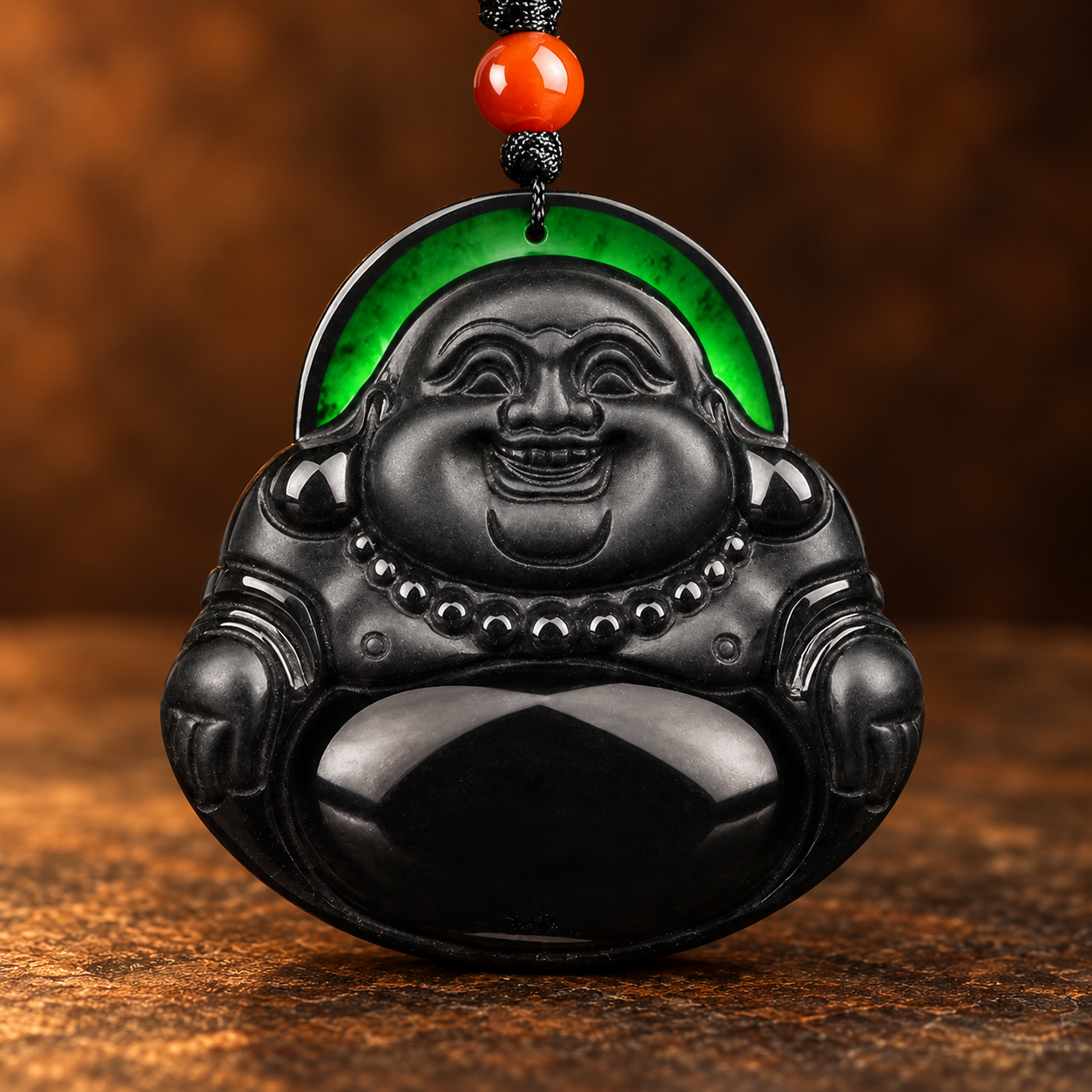
Our Ink Jadeite Laughing Buddha Pendant is described by its supplier as natural ink jadeite. The polished carving looks nearly black in ordinary light, while strong transmitted light through its thinner upper section can reveal green translucency. The stated dimensions are approximately 3.65 × 3.5 × 0.8 cm.
The round backplate, Budai relief and beaded-necklace detail give it a substantial-looking front while keeping it a small jewellery pendant. The listing shows a black braided attachment and orange-red bead. Read the current inclusion details rather than assuming a separate necklace chain comes with every pendant.
A softer colour in a smaller format
If the darker look feels too strong for your style, compare our Pale Green Jadeite Laughing Buddha Pendant. It has a supplier-stated approximate size of 2.5 cm and is offered as a loose carving without a chain, cord or metal bail. No certification or treatment-grade guarantee is claimed for that listing.
This is not simply a black-versus-green decision. You are also comparing the size, carving, attachment and information provided. A small loose piece may suit an existing mounting plan, while a broader relief has a different visual presence.
What meaning can you give the piece?
People may choose dark colours because they feel understated, formal or easy to coordinate. You can attach a personal reminder to that preference. Avoid assuming every tradition assigns exactly the same meaning to every black stone.
Budai’s smiling form may be the more meaningful part of the pendant for you. Our Buddha necklace meaning guide explains why identifying the figure matters. A thoughtful gift note can say why its expression reminded you of someone, rather than making claims about protection or guaranteed luck.
Check these details before ordering
- The exact material name and the basis for that description.
- Any treatment or certification information supplied for the item.
- Dimensions in millimetres or centimetres, not just a close-up image.
- The hole, attachment and included fittings.
- How the carving appears in normal room light.
Handle a pendant gently and follow its own care instructions. Avoid scratch, flame or chemical tests. If a significant purchase depends on identification, professional examination is more useful than a test that could mark the surface.
Common questions
Is black jade always dyed?
No such conclusion can be drawn from colour alone. Naturally dark jade materials exist, while treatment questions require evidence about the particular object.
Does green translucency prove jadeite?
No. Appearance under a light is not enough to determine material identity.
Is black jade automatically more valuable than green jade?
No. Colour alone is not a complete appraisal. Compare the item, documentation, carving and condition.
For the broader naming question, continue with jade vs jadeite.
Gemological references: GIA: jade quality factors; blackish-green omphacite jade; black nephrite jade.