Chinese Ingot Meaning: Yuanbao, Sycee and Laughing Buddha Designs
Published 18 October 2026 · Laughing Buddha Statue
A Chinese ingot motif usually expresses a wish for wealth or abundance. The familiar boat-like shape is often called a yuanbao in decorative descriptions, while sycee appears in accounts of historical Chinese ingot currency. A sculpted ingot held by the Laughing Buddha is a symbolic design detail, not a piece of spendable currency.
Knowing the difference helps you read a listing clearly. The ingot explains part of the imagery; the statue’s material, measurements and construction explain what you will actually receive.
From historical currency to decorative motif
The Smithsonian’s National Museum of American History records a silver boat- or slipper-shaped sycee ingot in its collection. The British Museum also documents Chinese silver currency ingots. Historical examples remind us that ingots were real monetary objects before their shapes became familiar decorative symbols.
Modern ornaments simplify and repeat that recognisable form. An ingot can sit in a figure’s hand, rise above a shoulder or form part of a base. It gives a visual shorthand for abundance without making the ornament itself a precious-metal asset.
How ingots appear in Laughing Buddha statues
Budai designs often combine a broad smile with bags, beads, coins or ingots. Look closely at which object is actually held. A curved ingot differs from a bowl, and a coin string differs from a prayer-bead loop. Our guide to Laughing Buddha designs is a useful companion when comparing the details.
The pose also changes the feeling of the piece. A seated figure holding an ingot can feel settled and substantial; a small standing figure with a raised ingot has a more upright, animated silhouette. Choose the expression you enjoy rather than ranking poses as if one guaranteed a stronger result.
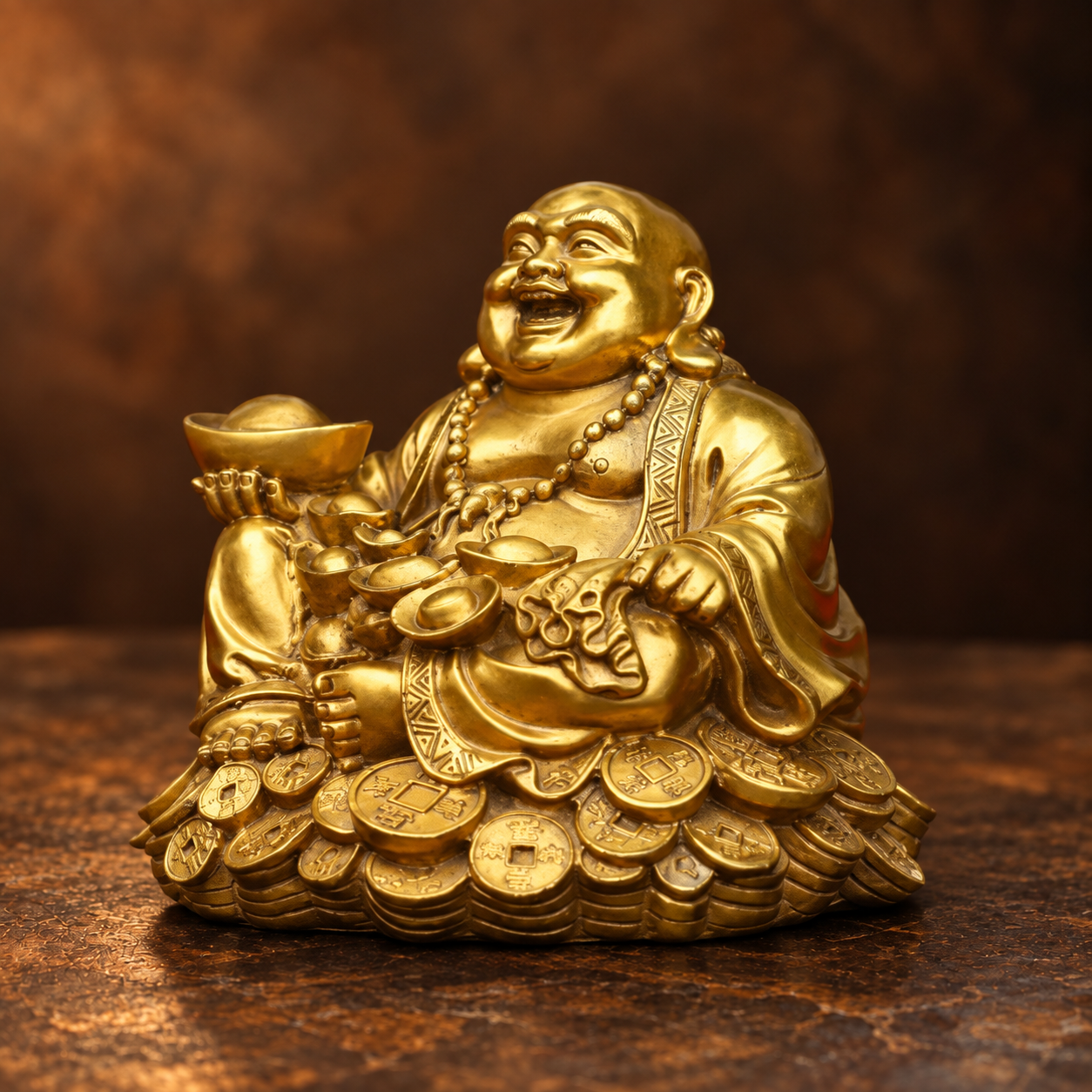
A seated copper figure with ingot and coins
Our Copper Laughing Buddha with Ingot and Coins makes the abundance imagery central to the design. It is listed as copper with a gold-coloured finish, approximately 14 cm high, 15 cm wide and 15 cm deep. The stated weight is about 1.74 kg.
This is a good example of why the full measurements matter. Its seated shape is relatively low but needs a broad surface. Check the shelf’s suitable load and allow room to lift the piece comfortably. The gold colour is a finish description, not a statement that the statue is solid gold.
A smaller raised-ingot alternative
For a personal desk corner, our Mini Green Laughing Buddha with Raised Ingot and Beads offers a lighter visual presence. The resin figure measures approximately 6 cm high, 5 cm wide and 3 cm deep. Its green finish distinguishes it from the gold-coloured seated copper piece while keeping the ingot motif visible.
A small figure works best where you will see it nearby. Place it beside, rather than behind, everyday objects. If you are choosing a gift, the compact format can be easier for the recipient to accommodate than a heavier display piece.
Give the symbol a personal message
For a new business, house move or career milestone, you might write: “A wish for a generous and rewarding next chapter.” This keeps the symbolism warm and personal. A gift can celebrate someone’s effort without suggesting that a statue controls their future earnings.
Ask whether the recipient enjoys the motif and has a place for the object. If they prefer a less explicit wealth theme, a simple smiling figure may suit them better. Our new-business gift guide compares useful and symbolic ways to celebrate an opening.
Before choosing an ingot design
- Read the material separately from the colour or finish.
- Check whether the ingot is sculpted into the piece or described as a separate part.
- Compare the whole base footprint and any stated weight.
- Choose a pose that works at your normal viewing distance.
- Follow the actual listing’s indoor-use and care instructions.
Is a gold-coloured ingot valuable metal?
Not necessarily. Gold colour is an appearance description. The featured statues are identified as finished copper and resin respectively.
Is an ingot the same as a money bag?
No. They can both contribute to abundance imagery, but they are distinct objects. A figure may include either or both.
Does the raised ingot need a particular compass direction?
The pose alone does not establish one universal placement rule. For traditional arrangements, follow a consistent school of feng shui; for decorative use, begin with a stable, suitable surface.
Historical references: Smithsonian: a silver boat-shaped sycee; British Museum: Chinese silver currency ingot.