
Why Is Buddha Fat? Understanding the Laughing Buddha’s Rounded Belly
The round-bellied figure people usually mean when they ask “why is Buddha fat?” is Budai, commonly called the Laughing Buddha. His exposed belly is a familiar identifying feature. He should not be confused with the historical Buddha, who is usually represented quite differently.
The short answer: you are probably looking at Budai
Budai appears in Chinese art as a portly monk, often with an open robe and a cloth sack. The Rijksmuseum identifies his bare belly and bag as recognizable attributes and associates the figure with contentment. The shape belongs to the character’s visual tradition; it is not a description of every Buddha.
This is why a seated, smiling ornament can look so different from a composed Buddha with carefully arranged robes. Before drawing a conclusion about the body, check which figure the artist or seller has actually represented.
What does the rounded belly mean?
The belly helps make Budai recognizable. Together with the relaxed robe and expression, it contributes to the generous, approachable character of many later images. A useful contemporary reading is contentment: a reminder to appreciate life rather than measure satisfaction only by possessions.
That reading is an interpretation of the figure’s cultural associations, not a claim that body size reveals someone’s wisdom or character. There is also no need to turn the belly into a promise of money, good health or a particular personal outcome.
In choosing a statue, consider what the whole expression says to you. Some Budai figures feel exuberant; others look restful or playful. The same exposed belly can appear in several different poses.
Has Budai always been shown laughing?
Even a familiar image has variations. Princeton University Art Museum’s Budai with Staff and Bag shows the portly monk with a downcast expression. Its interpretation contrasts that image with later cheerful portrayals. This is a helpful reminder that “Laughing Buddha” describes the figure’s widely familiar modern identity, not every historical depiction.
When comparing contemporary pieces, look beyond whether a statue is smiling. Notice the angle of the head, the relaxed or upright posture and how the hands relate to the objects. Those details often explain why one design feels more like your home than another.
See the identifying details in a simple design
Our Mini Gold-Colour Laughing Buddha with Fan puts several recognizable details together: the open robe, rounded belly, broad smile and shoulder staff with a small hanging bundle. The raised knee and leaf-shaped fan give this particular piece its easygoing character.
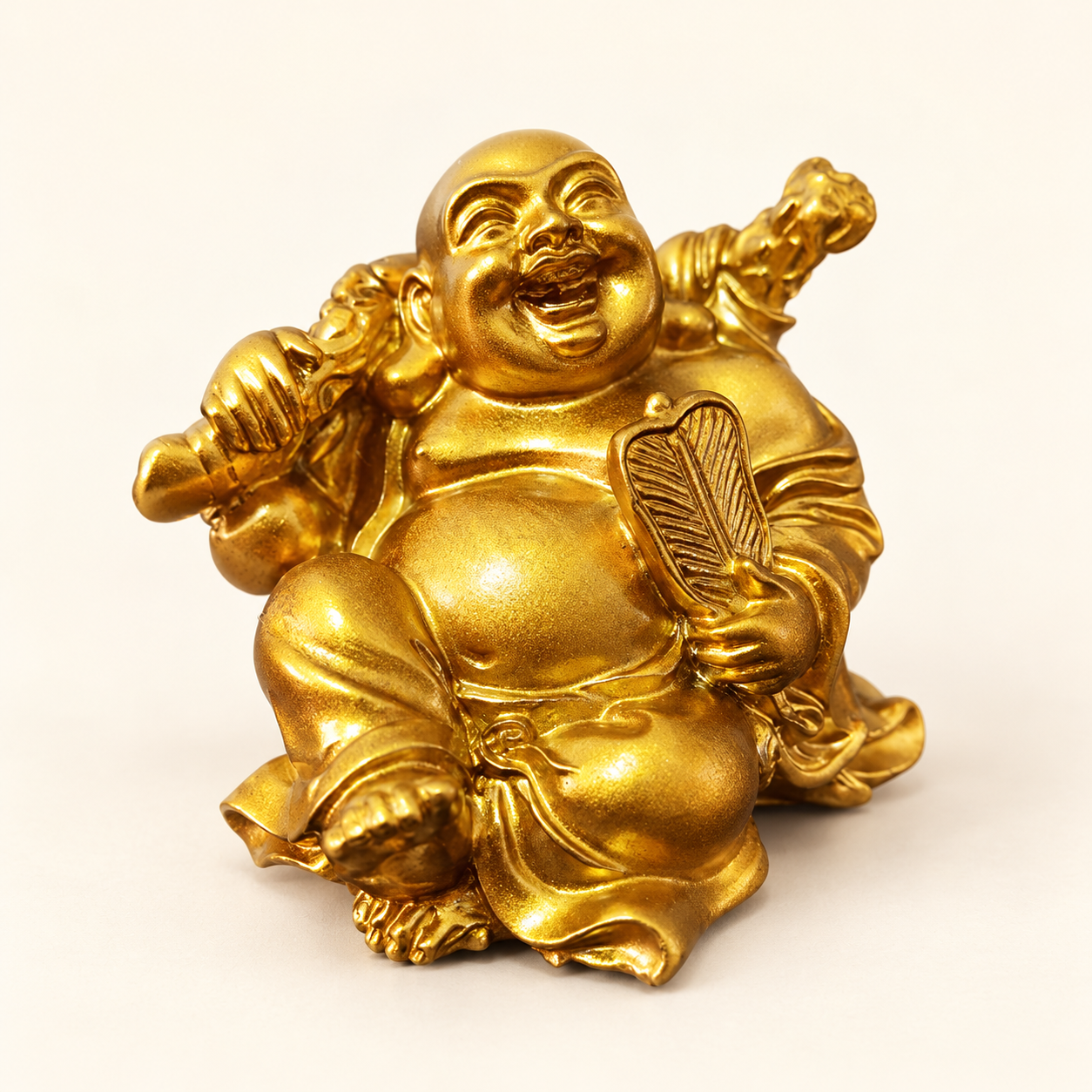
At approximately 1.97 inches high, it works as a little object to notice up close. The gold color is a decorative finish over supplier-described resin. If you like the expression, the product’s dimensions help you decide whether it belongs beside your books, near a reading chair or on a personal desk.
Is rubbing the belly required?
You may encounter the suggestion that rubbing a Laughing Buddha’s belly brings luck. Treat that as a popular custom or belief, rather than a requirement for owning a statue. A decorative piece does not need a ritual to be enjoyed, and repeated handling may be unsuitable for a delicate surface.
If a statue has significance within your religious practice, ask your community about its customs. For a personal display, following the product’s care instructions and appreciating the figure’s meaning is a considered starting point.
How to explain the figure when giving it as a gift
A short message can make the meaning clear without turning the gift into a lesson: “I chose his cheerful expression as a wish for more moments of contentment in your new chapter.” This connects the design to the recipient, rather than suggesting the object will change their circumstances.
Someone curious about the distinction between Budai and other figures can start with our guide to Budai, Hotei and the Laughing Buddha. If you want to compare the bags, fans and other objects on contemporary statues, explore the different Laughing Buddha designs next.
Continue exploring how to identify different Buddha statues when you are ready for the next decision.