
Money Frog Meaning: The Three-Legged Toad and Laughing Buddha
Published 18 October 2026 · Laughing Buddha Statue
The money frog, often called the three-legged money toad, is a Chinese auspicious motif associated with wealth and good fortune. It is connected with the figure Liu Hai in Chinese religious and artistic traditions. A decorative money-frog figure expresses a wish; owning one is not a guarantee of financial results.
You may see the frog alone, with coins, or in a scene that also includes the Laughing Buddha. Reading the whole design is more useful than assuming every smiling figure with a frog represents the same character.
Liu Hai and Budai are different figures
The British Museum’s account of Liu Hai connects him with the three-legged money toad. The Asian Art Museum also holds a figure of Liu Hai and his toad. These are helpful reference points when interpreting the motif.
Budai—the figure commonly called the Laughing Buddha—is a different subject. Our Budai and Hotei guide explains his familiar smiling face and rounded form. Modern decorative scenes can bring auspicious motifs together, so check the product’s stated identity and visible details rather than identifying a whole sculpture from the frog alone.
What do the coins and ingots add?
Coins and ingot shapes make the abundance theme visually clear. Look for whether these details form the base, sit beside the figure or are held in a hand. Their arrangement changes the appearance and footprint of the sculpture even when the general wish is similar.
When you are buying a gift, you can explain that wish in ordinary language: “A little celebration of your next chapter” is more personal than promising the object will bring income. The recipient’s taste and the space they have available should still guide the choice.
A small money-frog scene for your shelf
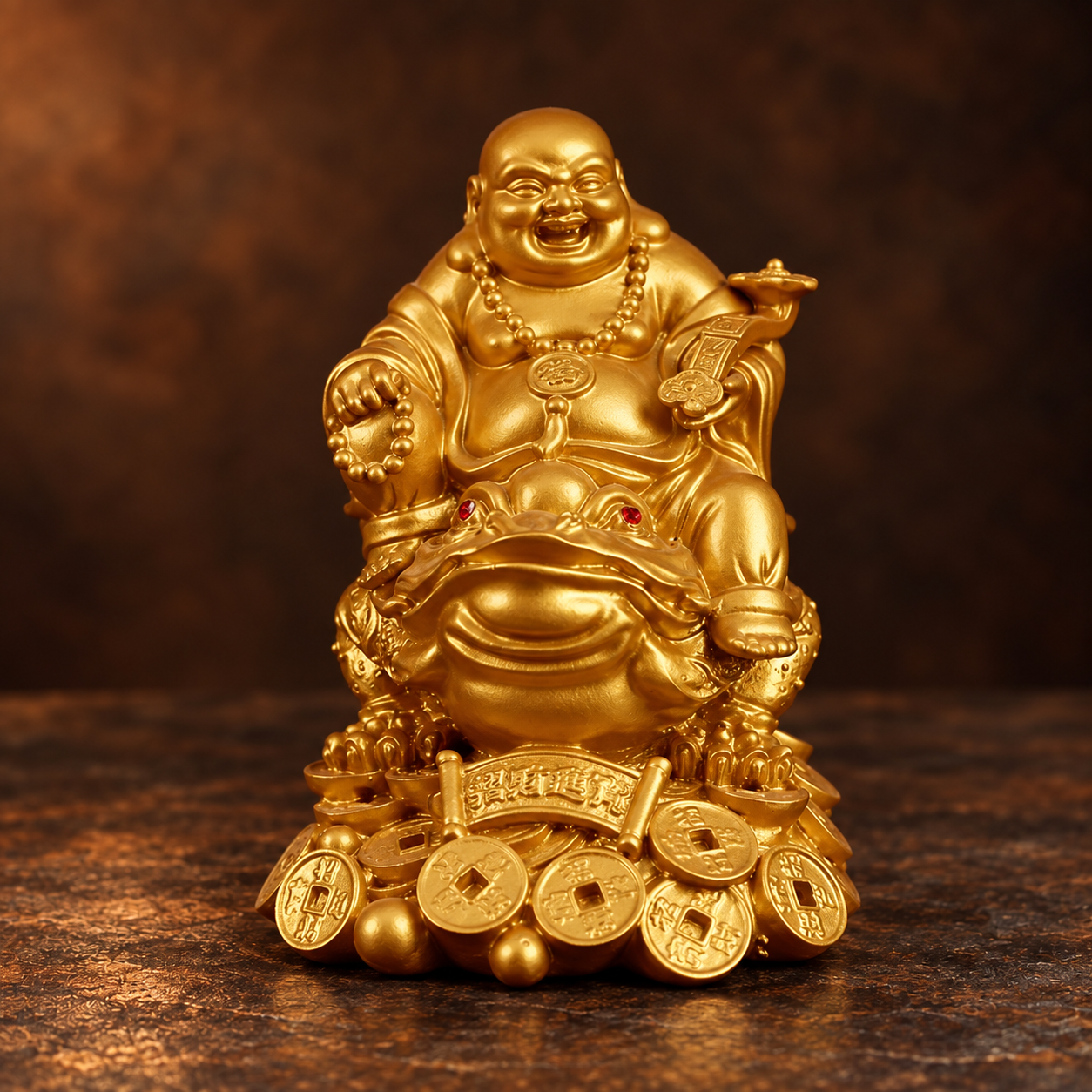
Our Resin Laughing Buddha on Money Frog combines a seated Budai, a money frog and a mound of coins and ingots. It is resin with a gold-coloured finish, approximately 7.5 cm high and 6 cm across. That makes it a small indoor accent rather than a large entrance statue.
The combined scene gives you several details to enjoy at close range. Try it on a clear shelf beside one book or a simple plant, with enough room to see the base. Its gold colour describes the finish; it is not a claim that the figure is made of solid gold.
Prefer a simpler abundance motif?
If the frog scene feels too detailed for your display, our Mini Green Laughing Buddha with Raised Ingot and Beads makes a quieter comparison. This resin figure has a green finish and measures approximately 6 × 5 × 3 cm in height, width and depth. The raised ingot carries the visual theme without adding a second animal figure.
Choose between the two by imagining the actual viewing distance. A detailed composite scene rewards a close look; a clearer silhouette can be easier to appreciate beside everyday desk items. Both should be chosen for their design and personal significance.
Where should a money frog go?
Feng shui placement advice varies by school and practitioner. A universal compass instruction cannot be inferred from a product photograph. If you follow a particular tradition, use that approach consistently; our bagua map guide explains why methods differ.
For practical decorative display, choose a dry, stable surface with room for the whole base. Keep the piece out of a door’s swing and away from places where bags, sleeves or cleaning tools will catch it. A symbolic object is easiest to enjoy when it fits the room you use every day.
Before you choose
- Identify whether you want a frog alone or a scene with Budai.
- Check material separately from gold or bronze colour.
- Measure the full footprint, not only the height.
- Choose a level indoor surface and follow the listing’s care instructions.
- For a gift, include the meaning as a thoughtful wish rather than a prediction.
Is the money frog the Laughing Buddha?
No. The frog is a separate motif. Some contemporary decorative pieces combine it with a figure identified as Budai.
Must the statue contain a removable coin?
Designs differ. Do not assume a loose coin or moving part is included unless the product details say so.
Explore Chinese ingot meaning for another detail commonly found in these scenes.
Museum references: British Museum: Liu Hai; Asian Art Museum: Liu Hai and his toad.