
Fish Symbolism in Chinese Art: Abundance, Pairs and Statue Designs
Published 18 October 2026 · Laughing Buddha Statue
Fish often express a wish for abundance in Chinese art because the Chinese word for fish, yu, sounds like a word for surplus. Other objects in the design can refine the message. A pair of fish, a lotus and a string of coins should be read as parts of a whole rather than as interchangeable symbols.
Understanding that visual language makes choosing a statue more personal. You can appreciate the wish behind a motif while also deciding whether the actual sculpture fits your home.
Why fish can mean abundance
The Metropolitan Museum of Art explains the fish-and-abundance wordplay in its record for Tang Guang’s Red lotus and fish. Another Met object uses paired fish with a chime to express wishes for happiness and abundance. These are examples of meaning emerging from combinations, not a rule that every fish image carries one identical message.
When you see fish on a modern keepsake, ask what else is present. An image can draw on traditional symbolism without reproducing a specific historical artwork. A product description should tell you what the particular object depicts.
Read a pair of fish as part of the scene
Begin with the main figure, then look down to the base and outward to the surrounding details. Are the fish the central subject, or do they support another figure? Are there coins, a lotus or a decorative plinth? Can the complete scene be seen from the front, or does it invite viewing from the side?
This way of looking also helps with buying. A broad base may matter more than the figure’s height on a shallow console. Fine details are easier to enjoy when the piece is close enough to see, rather than placed high above eye level.
A fish-pair scene with a generous smile
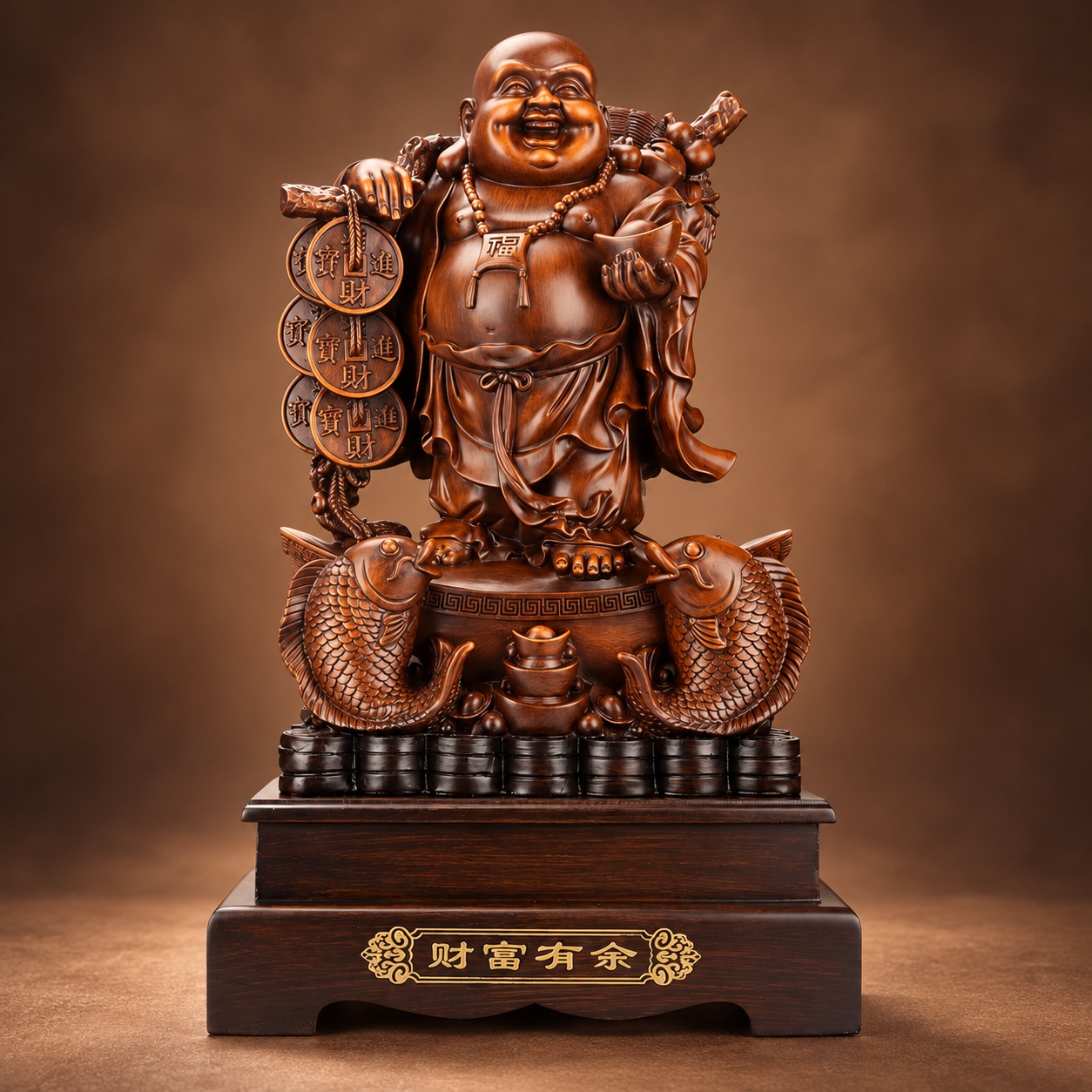
Our Laughing Buddha Statue with Fish Pair brings Budai above a pair of fish, with a coin string, flowing robes and a rectangular plinth. The listing describes resin in a brown bronze tone, approximately 23 cm high, 15 cm wide and 10 cm deep.
Those details make it a considered choice for a clear bookshelf bay or console. The fish-pair base adds an abundance theme, while Budai contributes his familiar joyful expression. It is an indoor decorative piece, and the bronze tone describes appearance rather than bronze metal construction.
Choosing between abundance and an “as you wish” motif
If the fish-pair scene has more presence than you want, our Ceramic Laughing Buddha with Ruyi offers a smaller alternative. Its ruyi scepter carries a different kind of auspicious wish, discussed in our ruyi meaning guide. The ceramic figure is approximately 7.5 cm high, 8 cm wide and 6.5 cm deep, with a dark-brown finish.
The comparison is useful for a gift: choose the motif and scale that suit the person rather than searching for one supposedly universal “luckiest” object. A recipient who loves detailed Chinese-inspired sculpture may enjoy the fish scene; someone with a modest shelf may prefer the compact ceramic figure.
How to explain the gift naturally
A short note is enough: “I chose the fish motif as a wish for abundance in your new home.” That shares the symbolism without predicting what will happen. You can make the message more personal by mentioning the recipient’s new chapter or the place where you imagined the piece.
Allow room for their own traditions. Someone may value the design mainly as sculpture, while another person enjoys the cultural wordplay. Both are reasonable ways to appreciate a decorative keepsake.
Plan the display before ordering
- Mark the full width and depth on the intended surface.
- Check the clear height above it.
- Make sure doors and drawers can open normally.
- Choose a background that lets the fish and robe details remain visible.
- Leave enough access for gentle dusting and safe handling.
For the featured fish-pair piece, use a stable indoor surface and a soft, dry cloth as its listing recommends. Do not assume an aquatic motif means the sculpture is suitable for water, an aquarium or outdoor exposure.
Common questions
Does a pair of fish always mean marriage?
No. Meaning depends on the context and accompanying motifs. The museum examples above illustrate abundance and happiness; avoid assigning one interpretation to every pair.
Is a fish-pair Budai the same as the Buddhist golden-fish symbol?
Not automatically. Similar motifs can appear in different traditions. Read the object’s identity and context; our Buddhist symbols guide provides a broader introduction.
Museum references: The Met: Red lotus and fish; fish, chime and auspicious wishes.